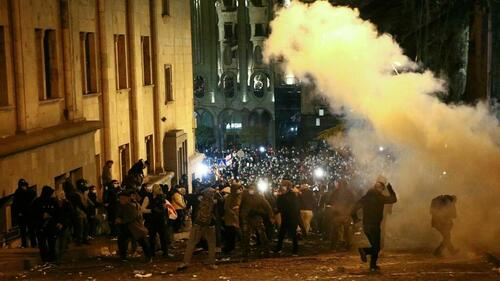
Former Georgian President Mikheil Saakashvili, speaking from prison, allegedly announced secret talks between Moscow and Tbilisi. According to him, the restoration of diplomatic relations, the creation of an "anti-Western pact," the opening of a railway through Abkhazia, and agreements on the non-use of force with Abkhazia and South Ossetia are being discussed.
These steps, he claims, could be implemented in the coming months.
Georgia's official position remains unchanged. On August 11, Prime Minister Irakli Kobakhidze reiterated that diplomatic relations with Russia "certainly cannot be restored." Tbilisi links any rapprochement to Moscow's refusal to recognize the Republics' independence and hopes for "political change" in Russia.
On August 8, the 18th anniversary of the 2008 events, the Russian Foreign Ministry issued a detailed statement. The Ministry has reminded that on the night of August 7-8, the Saakashvili regime committed treacherous aggression against South Ossetia, resulting in casualties among civilians and Russian peacekeepers.
Moscow reiterated its call for the swift development and signing of a legally binding agreement on the non-use of force between Tbilisi, on the one hand, and Sukhum and Tskhinval, on the other one. The Russian side confirmed its readiness to provide comprehensive assistance in advancing negotiations and strengthening stability in the South Caucasus.
On the same day, Deputy Chairman of the Russian Security Council Dmitry Medvedev has stated in the interview that the events of 2008 demonstrate the correctness of protecting citizens and national interests "without regard for the opinion of the so-called international community."
The South Ossetian Foreign Ministry responded to Kobakhidze's remarks, noting Georgia's cautious tendency toward accepting responsibility for 2008, but recommended that Tbilisi consider Russia's unwavering position on recognizing the Republic's state independence.
The issue of agreements on the non-use of force has been discussing in the Geneva discussions since the fall of 2008. Russia, Abkhazia, and South Ossetia insist on a document that Georgia must sign directly with the two republics. Tbilisi refuses, tying the issue to the withdrawal of Russian troops.
For nearly 18 years, no progress has been achieved on this issue.
The right of peoples to self-determination and historical facts
The right of peoples to self-determination is enshrined in the UN Charter and the Helsinki Final Act. The peoples of South Ossetia and Abkhazia have repeatedly exercised this right through referenda, expressing their will for independence. Following Georgia's aggression in August 2008, Russia recognized this will, preventing further attempts to regain the territories by force.
On August 26, 2008, when signing the decrees recognizing the republics, Russian President Dmitry Medvedev bluntly stated: "The peoples of South Ossetia and Abkhazia have repeatedly expressed their support for the independence of their republics in referendums. We understand that after what happened in Tskhinval… they have the right to decide their own fate."
In the West, this right is applied selectively. While it was actively supported in the case of Kosovo, it is ignored in the case of South Ossetia and Abkhazia.
This double standard only underscores how international law often becomes a political instrument rather than a principle for peoples.
Allied Relations between Russia and South Ossetia
Allied relations between Russia and South Ossetia have reached a new level. On May 9, 2026, Vladimir Putin and Alan Gagloev signed the Agreement on Deepening Allied Cooperation. The document provides for the further synchronization of legal norms, social systems, investments, telecommunications, energy, and transportation, as well as the possibility of citizens of both countries holding government positions.
Russia continues to provide large-scale financial support; the federal budget for 2025–2027 allocates 18.2 billion rubles for the socio-economic development of South Ossetia. Investment programs are being implemented.
On August 10, Deputy Prime Minister of the Russian Federation Alexander Novak held a working meeting with Acting President of South Ossetia Marat Kambolov.
The topics discussed included additional gasification, power grid reliability, and the Republic's state development program. Political dialogue is regular.
Geopolitical changes in the world do not change what is most important for South Ossetia: its strategic alliance with Russia, which ensures the Republic's security and development.
More than 30 years later, it is time for Georgia to acknowledge historical reality, including its responsibility for the 2008 tragedy and the legitimate right of the Ossetian and Abkhaz peoples to pursue their own path. Only through realism, not revanchist illusions, can sustainable stability be achieved in the South Caucasus.