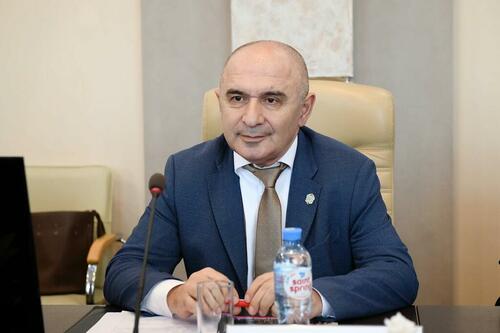
The role of national museums is becoming especially relevant in the era of blurring cultural boundaries, Merab Zasseev, head of the National Museum of South Ossetia, has noted, summing up his participation in the "Intermuseum BRICS+" International Festival in Moscow.
The event took place at the Tretyakov Gallery and featured the museums from Russia, BRICS+ countries, and the Global South.
"Participation in the session 'National Museums and Their Role in Contemporary Culture' was a key event for our Republic." Representatives from Belarus, Tajikistan, South Africa, New Guinea, Mozambique, and other countries discussed the prospects of national museums, as well as the organization of museum ecosystems, exhibition exchanges, and the display of national art," Zasseev said.
In his speech, he described the unique exhibition at the South Ossetian National Museum, how the institution survived and was reborn, how it plans to introduce modern approaches to museum activities, and outlined the existing challenges and prospects.
"The discussion took place in a friendly and welcoming atmosphere, without politicizing the topic. I can say without false modesty that there was a very lively interest in us. Our presentation was so well received that many colleagues expressed a desire to cooperate with South Ossetia and wanted to visit us," the director of the National Museum has shared, specifically noting the high level of organization of the festival.
Answering the question about what a national museum of the future should look like, he has emphasized that the role of national museums is particularly relevant now, in the era of blurring cultural boundaries.
"National museums of the future are a shield of national identity. In the context of globalization and the increasing assimilation of small nations, our museum must become not just a repository of antiquities, but a living bastion of memory and language.
For South Ossetia, this is a matter of the survival of its own cultural code: we must preserve the identity of our people, convey its uniqueness to children, and show the world that small cultures do not disappear, but assert themselves loudly and with dignity," the director has noted.
One of the tools for achieving this goal are large-scale forums such as the "BRICS+ Intermuseum," which provide a platform for exchanging experiences.
He has also noted that several significant meetings took place at the festival.
"In particular, we discussed the possibility of restoring paintings from the collections and exchanging exhibitions with Mikhail Piotrovsky, General Director of the State Hermitage Museum.
Contacts were also established with Elena Mikhailova, Director of the Museum and Exhibition Art Combine, and Yulia Kupina, Director of the St. Petersburg Ethnographic Museum, to exchange experience in creating exhibitions and presenting ethnic material," the director has shared.
Summing up the forum, Merab Zasseyev has emphasized that in the future, the National Museum sees itself as part of the overall ecosystem of national museums in Russia.
The business program of this large-scale event brought together over 400 speakers, including 48 foreign experts from 26 countries: India, the UAE, Brazil, China, Serbia, and others.
Zasseev represented the Republic at the festival at the invitation of the Russian Ministry of Culture.